


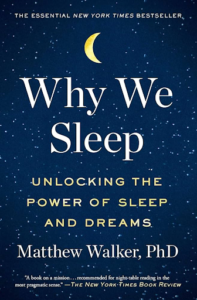
“Sleep is not the opposite of productivity. Sleep is the process by which the brain converts recent experience into lasting memory.” Professor Matthew Walker
For GCSE and A-level students at Ealing Independent College, academic progress is not only shaped by what happens in lessons, study periods and revision sessions. It is also shaped by what happens afterwards, particularly during sleep.
Sleep is often thought of as a period of rest after learning. However, research in neuroscience and psychology suggests that sleep is far more active than this. It plays a central role in memory consolidation: the process through which newly learned information is stabilised, strengthened and integrated into long-term memory. The guide PDF makes this point clearly, explaining that sleep is not simply rest, but an active and essential phase of learning.
For students preparing for GCSE and A-level examinations, this has important implications. Revision is not just about the number of hours spent at a desk. It is about how effectively the brain can encode, retrieve and consolidate information over time.
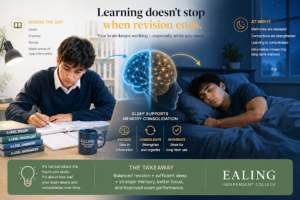
Learning does not end when the books close
During the school day, students encounter a large amount of new information. A GCSE student may learn a new algebraic method, revise a set of historical causes, practise a language tense or analyse a poem. An A-level student may engage with complex psychological theories, biological processes, geographical case studies or economic models.
At the point of first learning, this information is often fragile. A topic may feel clear during the lesson, but that does not mean it has been securely stored. This is why students can understand something on Monday but struggle to recall it later in the week. The issue is not necessarily effort or ability; it is often that the learning has not yet been consolidated.
Sleep supports this consolidation process. During slow-wave sleep, the hippocampus, which acts as a short-term memory system, replays aspects of the day’s learning. These reactivations help transfer information into wider cortical networks, where memories can become more stable and durable. Research describes this as the brain replaying the day’s experiences in compressed sequences, helping temporary learning become longer-term memory.
In practical terms, students may study during the day, but the brain continues to organise and strengthen that learning at night.
Why sleep matters during GCSE and A-level revision
GCSE and A-level courses require students to retain information across weeks, months and, in many cases, years. Success depends not only on understanding content at the time it is taught, but on being able to retrieve it accurately under exam conditions.
This is particularly important in subjects with heavy content demands. GCSE Science requires confident recall of key terminology, equations and required practicals. GCSE English Literature requires students to remember quotations, themes and contextual knowledge. A-level Psychology involves studies, theories, evaluation points and research methods. A-level Geography requires students to recall case-study evidence and apply it to unfamiliar questions.
In each case, sleep helps the brain protect learning from being lost. Without adequate sleep, students may still be able to work, but the quality of that work and the durability of the learning may be reduced.
Research associated with Matthew Walker and sleep science, note that sleep has been studied as an active phase of learning rather than a passive state of rest. It also refers to findings suggesting that insufficient sleep after learning can significantly reduce memory consolidation.
This has a clear message for revision: late-night cramming may feel productive, but it can undermine the very process students are trying to strengthen.
The problem with sacrificing sleep for revision
During exam periods, students can easily fall into the belief that more hours automatically means better preparation. This is understandable. When exams are approaching, staying up late can feel like commitment, and stopping work can feel risky.
However, tired revision is often inefficient revision. When students are sleep-deprived, attention, working memory, decision-making and emotional regulation can all be affected. This makes it harder to concentrate, harder to identify errors, harder to interpret exam questions and harder to remain calm under pressure.
There is also a deeper problem. If sleep is part of the learning process, then cutting sleep in order to revise may reduce the brain’s ability to store what has just been studied. A student may gain an extra hour of reading but lose some of the consolidation that would have made that reading useful later.
For GCSE and A-level students, the aim should not be to choose between revision and sleep. The aim should be to design a routine in which revision and sleep work together.
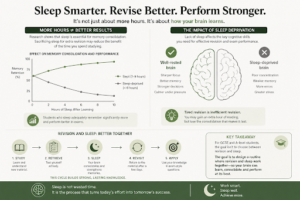
Sleep and the structure of memory
Different stages of sleep appear to support learning in different ways. Slow-wave sleep is strongly associated with the consolidation of factual and declarative knowledge: the kind of knowledge students need when recalling definitions, formulae, dates, processes, theories and case-study material.
REM sleep, often associated with dreaming, appears to support a different but equally valuable function. REM sleep helps connect new information with existing memory networks, enabling the brain to identify patterns, form associations and support insight.
This is particularly relevant for A-level students, where success often depends on more than recall. Students need to compare theories, evaluate evidence, apply knowledge to unfamiliar contexts and build coherent arguments. Sleep may, therefore, support both the storage of knowledge and the flexible thinking needed to use that knowledge well.
The hour before sleep: a useful review window
One practical implication is that the period before sleep can be used carefully. The research suggests that material reviewed shortly before sleep enters the consolidation process while it is still fresh.
This does not mean students should engage in intense, stressful cramming immediately before bed. High-pressure revision late at night may increase anxiety and make sleep more difficult. Instead, the final part of the evening can be used for calm, focused review.
For example, a GCSE student might spend 20 minutes reviewing Biology flashcards, recalling key formulae or testing themselves on quotations. An A-level student might summarise one theory, revisit a case study, plan an essay paragraph or review a small set of evaluation points.
The important distinction is between active recall and passive rereading. Simply looking over notes may feel reassuring, but retrieval strengthens memory more effectively. A short, calm self-test before winding down can be more valuable than an hour of tired highlighting.
What this means for revision planning
An effective revision timetable should include sleep as part of the learning plan, not as an afterthought. Students often plan what they will revise, but they do not always plan when they will stop. This can lead to revision becoming open-ended, especially in the weeks before examinations.
A more effective approach is to structure revision around learning, retrieval, spacing and sleep. For example:
A student learns or revises a topic during the afternoon.
Later that evening, they complete a short active recall task.
They sleep, allowing the brain to consolidate the material.
They revisit the same topic a few days later.
They apply it in an exam-style question.
This approach is particularly powerful when combined with spaced repetition. Students are not trying to force all learning into one long session. Instead, they return to material at intervals, allowing sleep and retrieval to strengthen memory over time.
A shared approach to academic success
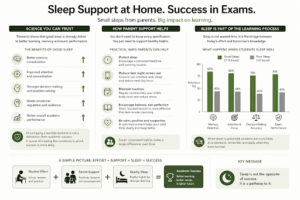
For parents supporting GCSE and A-level students, the science of sleep provides helpful reassurance. Encouraging a sensible bedtime is not a distraction from academic success. It is part of creating the conditions in which academic success is more likely.
Parents do not need to know every specification point or mark scheme to provide meaningful support. Helping students protect sleep, reduce late-night screen use, maintain routines and avoid panic-driven cramming can make a significant difference.
For students, the message is equally important. Sleep is not wasted time. It is not a sign that revision has stopped. It is part of the process through which the day’s effort becomes tomorrow’s knowledge.
Practical strategies for students
Students can make sleep work more effectively alongside revision by using a few simple habits.
First, they should avoid leaving the most demanding revision until late at night. Complex essay planning, difficult problem-solving or full past papers are usually better completed earlier in the day when concentration is stronger.
Second, they should use the final review of the evening for short, structured retrieval. This might include flashcards, blurting, quotation recall, formula checks or a short summary from memory.
Third, they should keep a consistent sleep schedule during revision periods. Large differences between weekday and weekend sleep patterns can make it harder to feel alert and focused.
Fourth, they should treat phones and screens carefully before bed. Notifications, social media and bright screens can delay sleep and keep the brain stimulated when it needs to wind down.
Finally, students should remember that sleep supports confidence. Knowledge feels more secure when it has been retrieved, revisited and consolidated over time.
Bringing it all together
The central lesson is straightforward: learning does not finish when revision ends. The brain continues to process, organise and strengthen information during sleep.
For students at Ealing Independent College, this matters because GCSE and A-level success depends on durable learning. Students need knowledge that lasts beyond the lesson, beyond the revision session and beyond the night before the exam.
Study is essential, but sleep helps make study stick. A strong revision routine should therefore include focused work, active recall, spaced practice and proper rest. Sleep is not the opposite of productivity. It is one of the ways the brain turns effort into lasting learning.
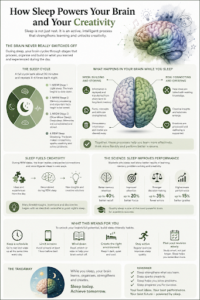
Further reading:
Co-Principal
James