


For GCSE and A-level students at Ealing Independent College, revision is not simply about working harder. It is about working with the way memory actually behaves.

Revision feels most effective when it is organised around retrieval, spacing and repeated use.
During revision, many students make the same understandable mistake: they measure the quality of their revision by the number of hours spent at a desk, the number of pages highlighted, or the quantity of notes rewritten. These activities can feel reassuring, but they do not always tell us whether learning will still be accessible in an exam room two weeks later.
The reason is simple: memory is not a filing cabinet. It is a living system that strengthens when information is retrieved, used and revisited at the right time. This idea is often associated with the German psychologist Hermann Ebbinghaus, whose work on memory led to the well-known “forgetting curve”. Ebbinghaus tested memory over time and showed that, without review, recall drops sharply after learning, Über das Gedächtnis (1885; Memory).
The forgetting curve
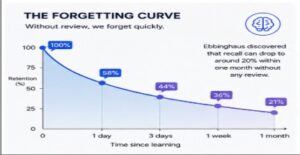
Without review, recall typically falls quickly after first exposure. This is why a lesson that felt clear on Monday can feel distant by Friday.
The forgetting curve is a useful way of explaining a common student experience. A Year 11 student may understand a Chemistry calculation perfectly during a lesson. An A-level Psychology student may be able to explain a research method immediately after class. Yet when they return to the same material days later, the fluency has weakened. This is not usually a sign that the student is “bad at remembering”. It is a sign that the brain has not yet been asked to retrieve that knowledge often enough for it to become durable.
This matters across GCSE and A-level subjects. In GCSE Mathematics, students need procedures to be available quickly and accurately. In A-level Biology, the volume of terminology can be demanding. In A-level Geography or Psychology, students must not only remember concepts but also select them, apply them and evaluate them under timed conditions. In every case, memory has to survive delay, pressure and distraction.
Why cramming feels productive but often disappoints
Key revision question: Could I explain this without looking at my notes, and could I still do so tomorrow, next week and next month?
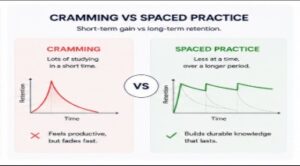
Massed practice, often called cramming, can create a short-term feeling of success. A student spends several hours the night before an assessment rereading a topic, and the next morning the information feels familiar. The problem is that familiarity is not the same as secure recall. Cramming can help with immediate recognition, but it often does not create the repeated retrieval needed for long-term retention.
For students, this is a crucial distinction. Reading through notes may make a page look familiar. Highlighting may make key terms stand out. Copying may produce neat revision materials. But an exam does not ask, “Have you seen this before?” It asks the student to retrieve, organise and apply knowledge independently.
The antidote: spaced repetition
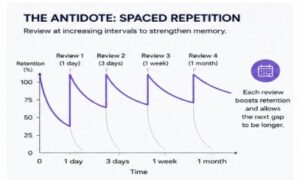
Spaced repetition interrupts forgetting. Each well-timed review strengthens recall and allows the next interval to be longer.
Review information at increasing intervals. A simple pattern might be: one day later, three days later, one week later, and one month later. The purpose is not to review everything all the time. The purpose is to revisit material just as it is beginning to fade.
This is why a revision timetable should not simply list subjects. It should list returns. For example, after learning a topic in A-level Economics on Monday, the student might answer five retrieval questions on Tuesday, complete a short exam-style question on Friday, revisit the same concept the following week, and then include it in a mixed-topic practice session later in the month.
What this looks like for GCSE and A-level students
At GCSE, spaced repetition can be built around small, frequent retrieval tasks: vocabulary checks in languages, formula recall in Physics, key quotation recall in English Literature, or short-answer knowledge questions in History. The review does not need to be long. Ten focused minutes can be more valuable than an hour of passive rereading.
At A-level, the same principle applies, but the retrieval should become more sophisticated. Students should move from definitions to explanation, from explanation to application, and from application to evaluation. An A-level Psychology student might first recall the steps of a study, then explain a methodological limitation, then apply that limitation to a new scenario. An A-level Geography student might first recall a case-study fact, then use it in a paragraph, then compare it with another place.
A practical revision system
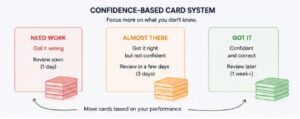
A confidence-based card system helps students spend more time on what is weakest and less time on what is already secure.
One practical method is a confidence-based card system. Students place questions, definitions, case-study prompts, formulae or essay plans into different boxes. Cards answered correctly move to a longer interval. Cards answered incorrectly return to the start. This means students do not waste most of their time reviewing what they already know. Instead, they focus on the knowledge most at risk of disappearing.
A strong revision session might follow this sequence:
- Start with retrieval: close the notes and write down what can be remembered.
- Check accuracy: compare the answer with class notes, mark schemes or model answers.
- Repair gaps: correct errors and add missing detail.
- Schedule the next review: return tomorrow, then in a few days, then next week.
- Apply the knowledge: use it in a past-paper question or exam-style paragraph.
The message for revision season
The most encouraging lesson from the forgetting curve is that forgetting is normal. Students should not panic when knowledge feels less secure a few days after learning it. That moment is not failure; it is an opportunity. The right response is not to start again from the beginning, but to retrieve, check, strengthen and schedule the next return.
For students at Ealing Independent College, this means revision should be strategic. Build a timetable that revisits material. Use active recall before rereading. Practise past-paper questions repeatedly, not just once. Track weak areas honestly. Let confidence grow because knowledge has been tested over time, not because it looked familiar the night before.
Memory may follow a predictable decay curve, but revision can bend that curve. The schedule matters. The timing matters. The act of retrieval matters. Students who understand this can make revision more efficient, less stressful and more likely to produce the kind of lasting learning that examinations require.

Co-Principal
James