


As examinations draw ever closer, students now enter a crucial phase of focused and purposeful revision. Over recent weeks, teachers have worked meticulously to equip students with the subject knowledge, skills, and exam strategies required to navigate the demands of their courses with confidence. With core content covered and mock examinations completed, attention now turns to the final mock examinations, which will begin on 18 March for both GCSE and A Level students. These assessments provide an invaluable rehearsal for the final examinations, scheduled to commence around 12 May.
With time now at a premium, students are encouraged to consolidate their learning by producing effective revision notes and establishing structured, realistic study schedules. The question many students and families ask at this stage is how revision can be made more efficient and impactful. In recent months, growing interest in artificial intelligence (AI) within education has highlighted its potential to support and enhance independent study when used appropriately.
This blog explores practical ways in which AI can be used as a supportive revision tool, with a particular focus on GCSE study. Earlier this week’s assembly introduced students to a range of proven revision strategies, including mind maps, spider diagrams, flashcards, and the Pomodoro technique, all designed to promote active learning and sustained concentration. When combined thoughtfully with AI, these approaches can be further strengthened.
AI-powered tools can assist students by generating additional practice questions, providing immediate feedback on spelling and grammar, and offering rapid access to explanations, summaries, and analysis. Used responsibly, AI can help students check understanding, identify gaps in knowledge, and maintain momentum during revision sessions. By integrating these tools into their existing revision strategies, students are better placed to remain focused, organised, and confident as they prepare for the challenges ahead.
Ready to unlock your superhero learning powers with AI? Forget boring textbooks for a second – think of AI as your personal academic sidekick, always there to help you crush those GCSEs!
As Albert Einstein (who probably would have loved AI!) once said: “The important thing is not to stop questioning. Curiosity has its own reason for existence.” Let AI fuel that curiosity and make learning an adventure!
Here’s how you, a GCSE student, can use AI like a boss:
1. Your personal AI Study Buddy: “Brain Booster!”
Imagine having a super-smart friend who can explain anything in a way that just clicks for you. That’s AI! It’s like having a tutor available 24/7, ready to break down tough topics, answer your “silly questions,” and cheer you on.
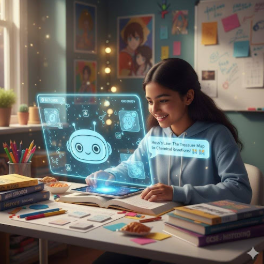
“The only way to do great work is to love what you do.” – Steve Jobs (and we’re gonna make you love learning!)
Here’s how to use your “Brain Booster” AI:
- Concept Un-puzzler: Stuck on a tricky science concept? Ask AI to explain it using emojis, a story, or even a rap!
- Prompt example: “Explain photosynthesis (GCSE Biology) to me like I’m explaining it to a friendly alien, using simple words and a diagram analogy!”
- Weak Spot Warrior: Got a recurring mistake in Maths? AI can give you endless practice questions focused just on that.
- Prompt example: “I keep messing up my GCSE Maths probability questions. Give me 5 practice problems and show me the first step for each.”
- Debate Prep Master: Need to argue a point for English or History? AI can play devil’s advocate and help you build strong arguments.
- Prompt example: “I’m writing an essay on Romeo and Juliet (GCSE English Literature). Give me three arguments for why Romeo is impulsive and three counter-arguments.”

2. Your AI Productivity Pal: “Time Saver Turbo!”
Revision can feel like a mountain of notes. AI is your secret weapon to climb it faster! It’s like having a super-efficient robot assistant that organises your study materials and makes revision snappier.
“The expert in anything was once a beginner.” – Helen Hayes (and AI helps you get there faster!)
Here’s how to use your “Time Saver Turbo” AI:
- Flashcard Factory: Turn boring notes into awesome flashcards in seconds! No more endless writing.
- Prompt example: “Take my GCSE Chemistry notes on the periodic table and turn them into 20 fun flashcards with questions on one side and answers on the other.”
- Summary Superstar: Got a long article or chapter for History or English? AI can summarise it so you get the main points without getting lost.
- Prompt example: “Summarise this article about the causes of World War 1 into 5 key bullet points for my GCSE History revision.”
- Revision Rota Robot: Struggling to make a study plan? AI can create a personalised revision timetable for you!
- Prompt example: “I have my GCSE Science exam in two weeks. Create a revision schedule focusing on Physics for 3 days, Chemistry for 3 days, and Biology for 3 days, with a break each day!”

3. Your AI skill sharpening sidekick: “Ace Your Work!”
Want to write better essays, get your points across clearly, and generally impress your teachers? AI can help you polish your work until it shines!
“Success is not final, failure is not fatal: it is the courage to continue that counts.” – Winston Churchill (and AI gives you that extra push!)
Here’s how to use your “Ace Your Work” AI:
- Writing Wizard: Improve your grammar, spelling, and even find better words for your essays!
- Prompt example: “Review this paragraph from my GCSE English Literature essay on Macbeth. Can you suggest any stronger vocabulary or ways to make my arguments clearer?”
- Idea Generator: Stuck on how to start an essay or what points to include? AI can help you brainstorm!
- Prompt example: “Give me three different ways to introduce an essay on the impact of rivers on human settlement for GCSE Geography.”
- Coding Coach: For Computer Science, AI can help you understand code or find those annoying little mistakes that stop your programs from working.
- Prompt example: “I’ve written this Python code for my GCSE Computer Science project, but it’s not working. Can you tell me what’s wrong and how to fix it?”
The Golden Rules for AI Super-Students!
Remember, with great power comes great responsibility! Use AI wisely to truly boost your learning:
- Always Double-Check: AI is smart, but it can sometimes make mistakes. Always check the facts it gives you with your textbook or teacher!
- Your Brain First!: Try to do the work yourself first. Then, use AI to check your answers, explain mistakes, or make your work even better. It’s about learning with AI, not letting AI do your learning for you!
- Talk to Your Teachers: If you’re unsure about how much AI you can use, just ask your teacher! They’ll appreciate your honesty.
- Be a Prompt Pro: The clearer your instructions, the better AI will help you. Think of it like giving directions – the more detail, the easier it is to follow!
“The future belongs to those who believe in the beauty of their dreams.” – Eleanor Roosevelt.
Go on, dream big and use AI to help you achieve those dreams, one amazing GCSE grade at a time!
Co Principals
James and Laura